
2027: The Real Cost of Global Layoffs — Beyond the Workplace
AI, corporate restructuring and the financial pressure facing households.
Global companies are restructuring, investing heavily in artificial intelligence and reconsidering how many employees they need. While many job reductions have already been announced in 2026, some restructuring programmes will continue into 2027.
The real concern is not simply how many jobs disappear. It is what happens when prolonged unemployment begins affecting household savings, consumer spending and economic confidence.
The Numbers Reveal a Changing Employment Market
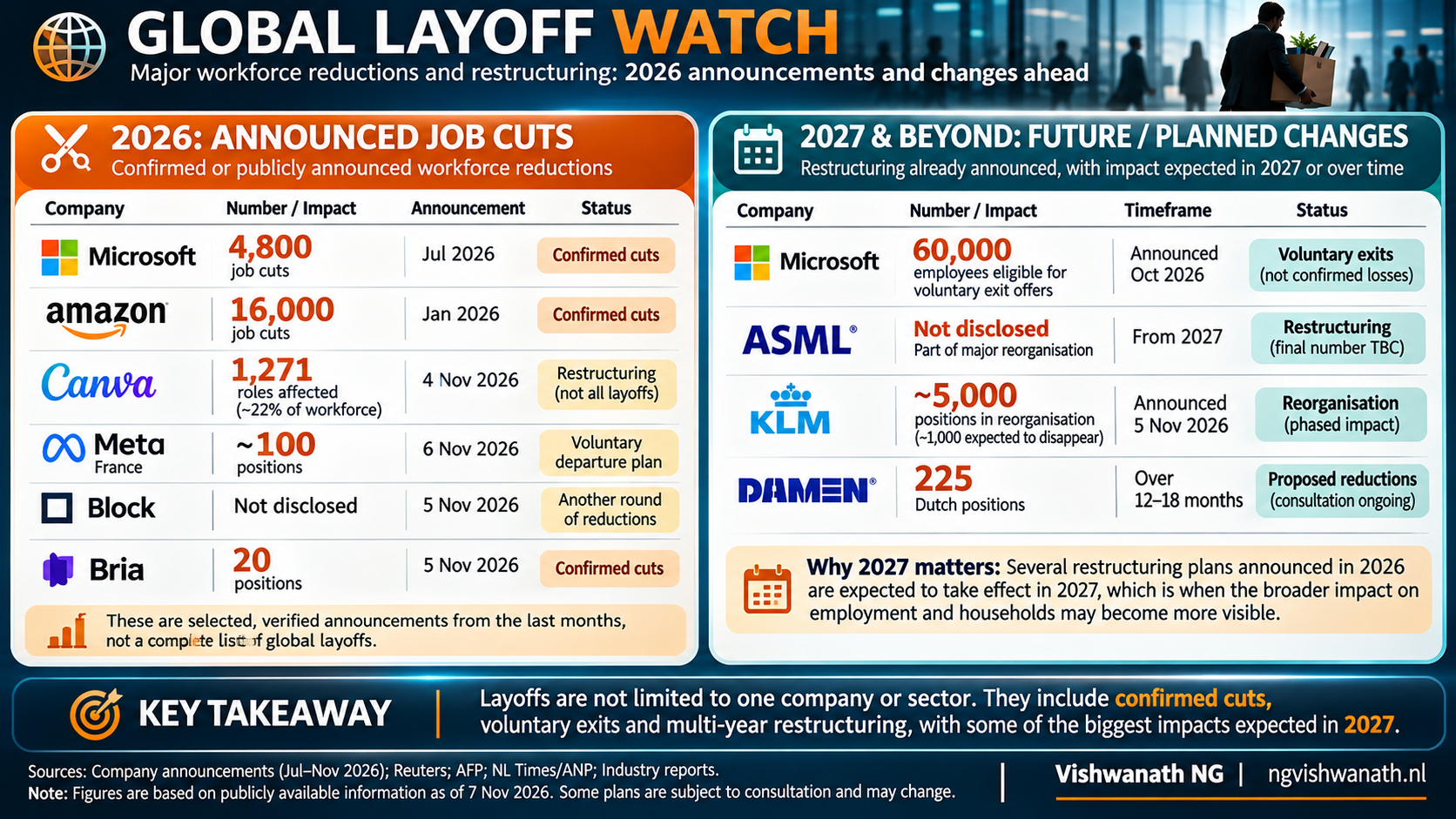
Microsoft, Amazon, Canva and other major companies have announced workforce reductions or restructuring programmes during 2026. Some have also introduced voluntary departure options or changes scheduled over several years.
However, the wider statistics reveal an important distinction.
According to Challenger, Gray & Christmas, US employers announced 617,189 job cuts between January and October 2026, approximately 44% fewer than during the same period in 2025.
Technology was an exception, with 171,501 announced cuts, an increase of 21% year on year.
These figures suggest that employment pressure is not rising equally across every industry. Instead, particular sectors are experiencing significant changes while others continue recruiting.
US Announced Job Cuts
January–October, 2025 versus 2026
Source: Challenger, Gray & Christmas, November 2026. These are US employer announcements, not a worldwide layoff count or a count of completed dismissals.
Artificial Intelligence Is Part of the Explanation
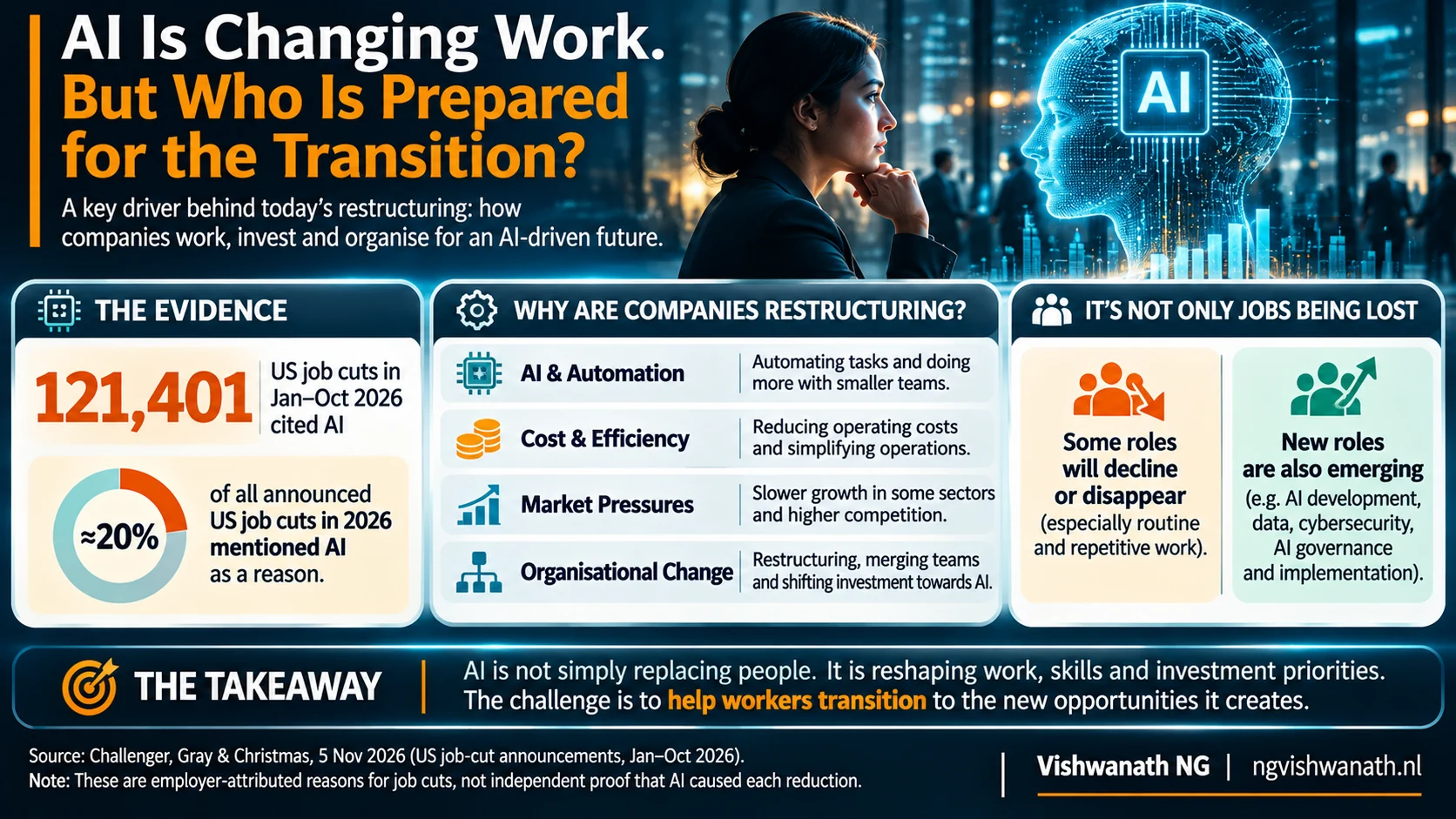
AI is changing how companies organise work, automate tasks and allocate investment.
During January–October 2026, US employers cited artificial intelligence in 121,401 announced job cuts, approximately one-fifth of the total.
That does not mean AI independently caused every dismissal.
Companies are also responding to weaker demand, operating costs, competition and organisational inefficiencies. Market and economic conditions overtook AI as the leading employer-reported reason for US job-cut announcements in October.
The deeper change is that companies can continue growing and investing while reducing certain existing roles.
AI may create opportunities in software, data, cybersecurity and emerging industries. But these opportunities may require different skills from those held by displaced employees.
Why 2027 Could Become Financially Difficult for Some Households
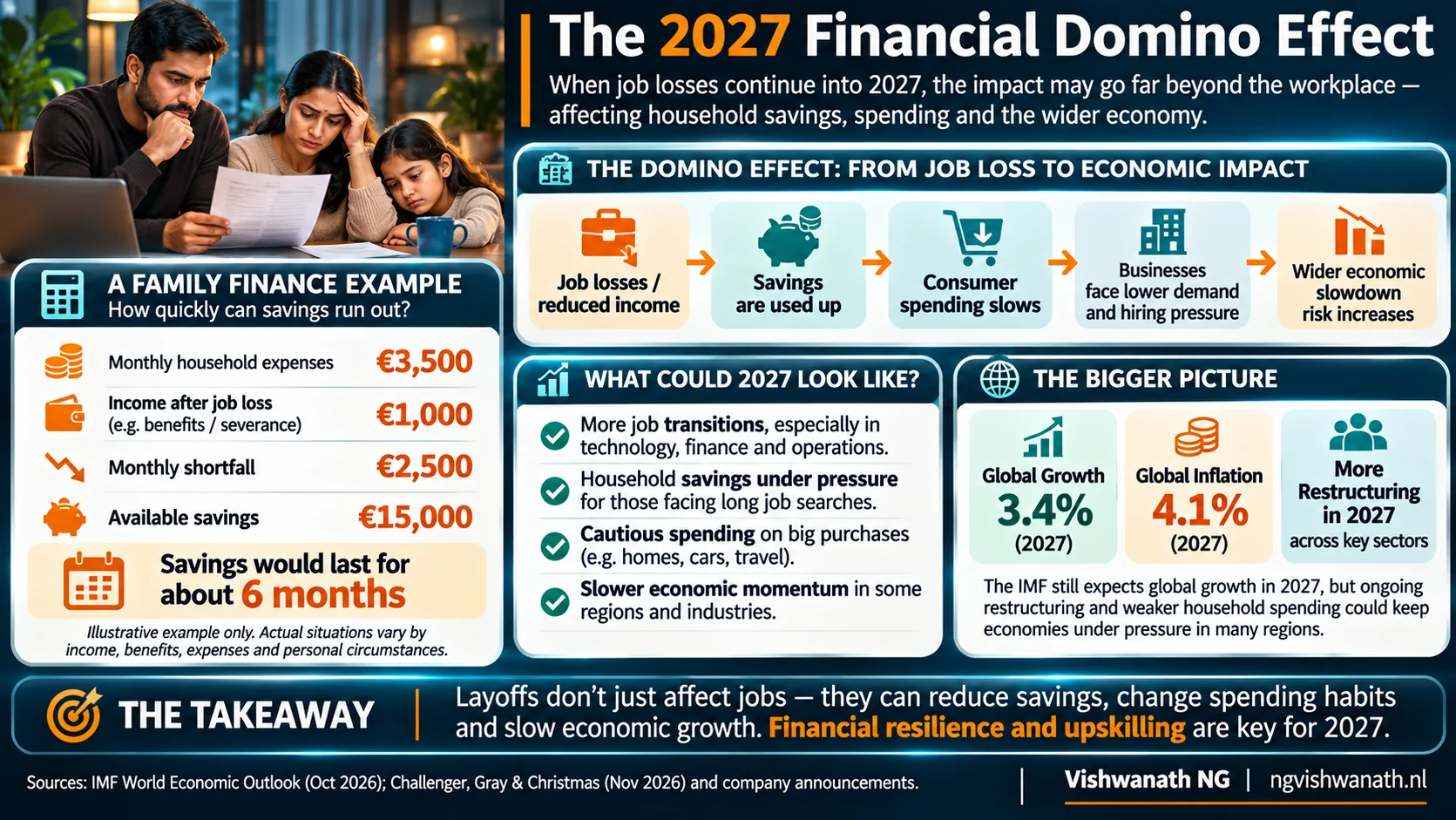
Corporate restructuring announcements and actual job losses often happen months apart. Some reductions announced during 2026 will take effect during 2027 or continue over several years.
For affected households, the consequences can be immediate.
What Happens When Household Income Falls?
Illustrative calculation only. Assumes expenses and income remain unchanged. Excludes severance, benefits, taxes, investment returns and unexpected costs.
A family without savings could experience financial difficulty much sooner.
Prolonged unemployment may force households to postpone major purchases, reduce discretionary spending or draw down financial reserves.
If this happens across a sufficiently large number of households, lower consumer spending can weaken demand for businesses, potentially affecting investment and recruitment.
This is how employment difficulties can spread beyond the workplace into the wider economy.
Europe and Brainport Eindhoven: A Regional Example
Europe is also experiencing restructuring across technology, manufacturing, aviation and financial services.
In the Netherlands, companies including ASML, Damen and KLM have announced workforce changes, with some programmes extending into 2027.
For Brainport Eindhoven, employment uncertainty carries an additional consideration. International professionals who have purchased homes and established families in the region may face difficult financial and relocation decisions if they cannot secure alternative employment.
This does not establish that layoffs will cause a housing downturn. It illustrates how employment changes can affect other areas of the economy.
Are We Heading Towards Another 2008-Style Recession?
The evidence does not currently establish that another global financial crisis is approaching.
The International Monetary Fund forecasts global economic growth of 3.1% in 2026 and 3.4% in 2027, while global inflation is projected to ease from 4.7% to 4.1%.
Global Economic Outlook
IMF October 2026 projections
Bars share a 0–5% scale. Source: IMF World Economic Outlook, October 2026. Forecasts are subject to revision.
These forecasts suggest continued global growth, although economic conditions remain uneven.
The 2008 crisis was fundamentally associated with financial-system vulnerabilities and a collapse in credit confidence. Today's corporate restructuring has multiple causes, including technological transformation, competition and economic pressures.
Layoffs alone are therefore not evidence of another 2008.
But for a household facing unemployment, a growing economy does not guarantee financial security.
Preparing for the Next Employment Transition
The evidence points to a practical conclusion.
Workers need to assess their financial resilience and changing skill requirements. Employers need to consider how restructuring affects employees and whether retraining or redeployment can reduce disruption.
Educational institutions and industry organisations can help connect displaced workers with emerging opportunities.
Innovation and economic growth remain important. But the people affected by changing employment structures must also be part of that future.
Companies are preparing for the next generation of technology. Are workers and households equally prepared for the next generation of employment?
Sources & References
- Challenger, Gray & Christmas — October 2026 Job Cuts Report (published 5 November 2026).
- International Monetary Fund — World Economic Outlook, October 2026 .
- IMF World Economic Outlook Database .
- ASML — Official News and Announcements .
- KLM — Official Newsroom .
- Damen Shipyards — Corporate Website .
Editorial note: Corporate announcements can refer to confirmed redundancies, proposed reductions, affected positions, voluntary exit eligibility or broader reorganisations. These should not be added together as a single global layoff total. Figures reflect information available at the time of publication.

Vishwanath NG
Vishwanath NG writes about technology, employment, economic change and their impact on communities and households. His commentary explores the relationship between global developments and everyday financial decisions.
Visit ngvishwanath.nl